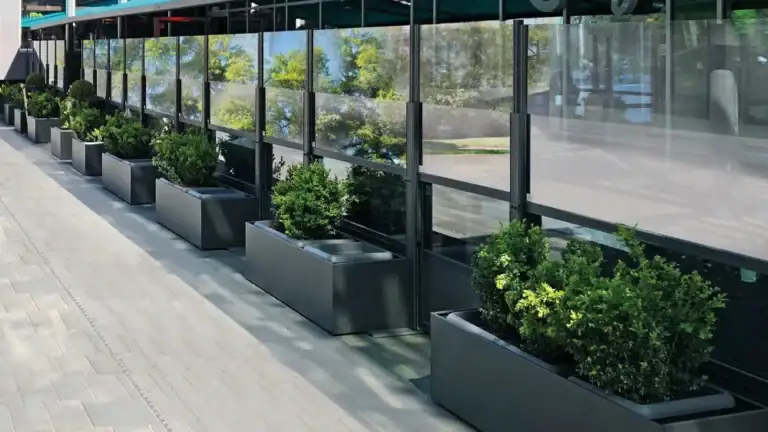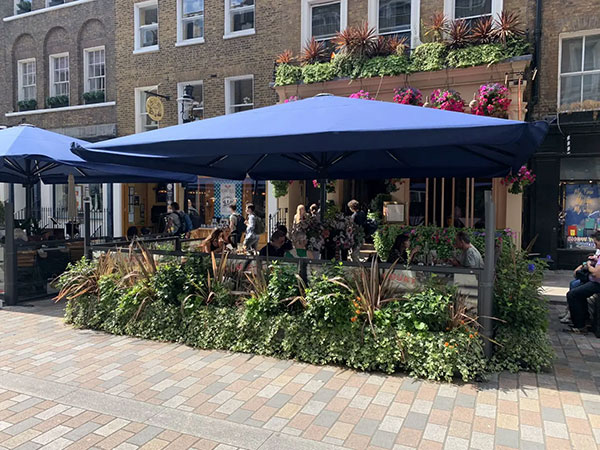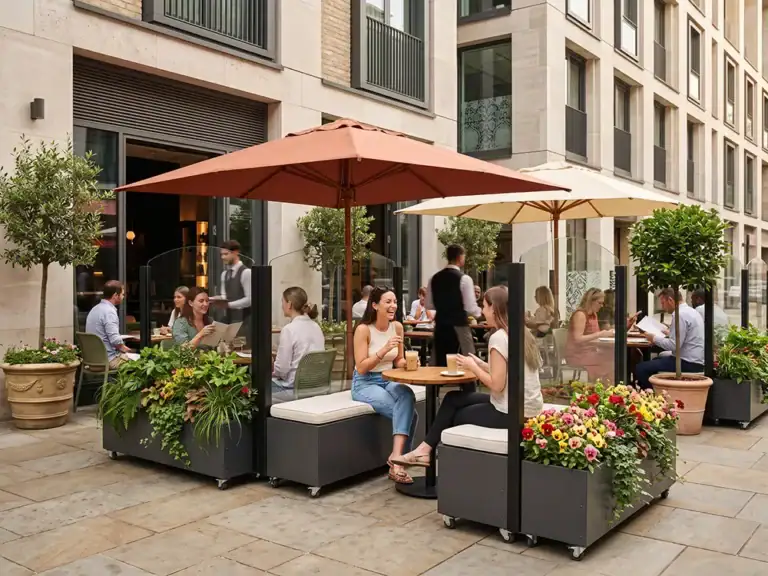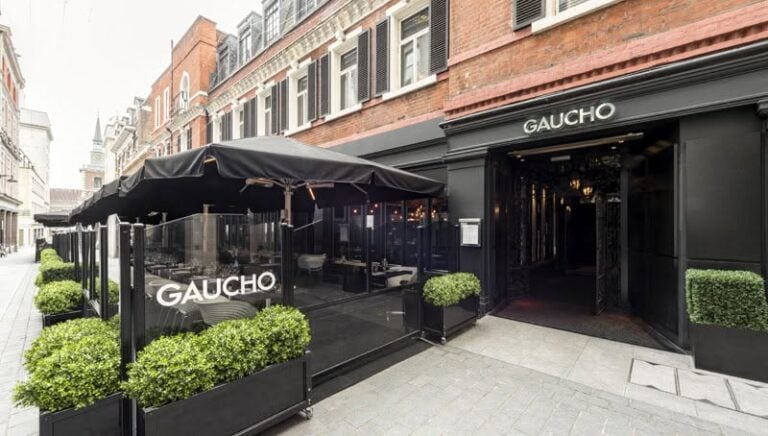
A pavement terrace has a few seconds to persuade a passer-by to sit down. Planters with screens help it do that: they make the terrace look finished, give guests shelter, and show exactly where your licensed area begins. This guide covers what planter screens do on a pavement, what licence rules allow, how to choose and lay them out, and what to plant. For the full range, see restaurant planters and benches.
Contents
- What are planters with screens?
- How do planters with screens make a pavement terrace more profitable?
- What does a pavement licence allow?
- Which planter screen suits a pavement terrace?
- How should you lay out planter screens on a pavement?
- What should you plant in terrace planters?
- FAQs
What are planters with screens?
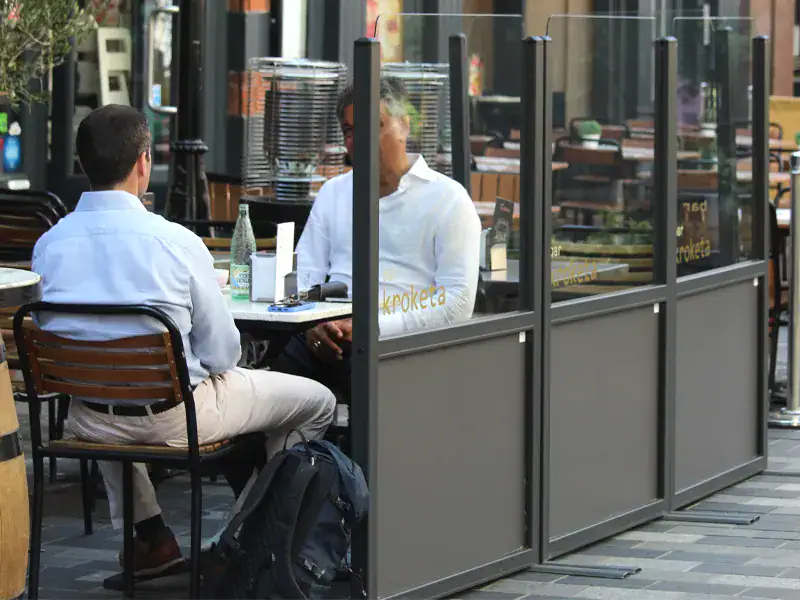
Planters with screens are planter boxes with a glazed windbreak panel fixed above them. The planter forms the weighted base and the safety glass forms the screen.

They differ from plain planters, which mark space but give no wind shelter. They also differ from café barriers, which carry branding but stand at waist height. For a fuller comparison, see our guide to café barriers and freestanding terrace screens.
How do planters with screens make a pavement terrace more profitable?
Planters with screens make a pavement terrace more profitable by keeping guests comfortable for longer, on more days, and by drawing in passing trade. They work in five ways:
- Comfort. Glass blocks the wind reaching seated guests while keeping the street view open. Wind is often what moves guests indoors first. The City of London Corporation’s wind guidelines treat 2.5 m/s as the limit for frequent outdoor sitting, such as a restaurant or café.
- Separation from the street. A screened edge puts a visible barrier between diners and passing pedestrians and traffic. Terrazzo describes its screens as blocking both wind and street noise.
- Kerb appeal. Greenery and a clean glazed line make the terrace look intentional and cared for, which helps it stand out from a row of bare tables.
- Brand visibility. Logos and artwork can go on the glass or panels, so the terrace works as signage all day.
- Longer seasons. Sheltered tables stay usable into autumn and spring, especially when paired with overhead heating.
Planter screens also divide larger terraces into zones, such as dining, drinks and private hire. See how zoning your restaurant terrace can maximise your profits year-round.
What does a pavement licence allow?
In England, a pavement licence allows removable furniture used for outdoor food and drink, including barriers. Planters with screens must fit within its rules. According to the GOV.UK pavement licences guidance:
- Furniture must be removable. It must not be a fixed structure, and generally must be able to be moved and stored at night.
- Barriers can be required. Councils may require a barrier between furniture and the rest of the footway, with colour contrast and a tap rail for people using long canes.
- Advertising boards must not be used as barriers. Check with your council before relying on branded panels as your terrace edge.
- A clear route must remain. 2,000mm of footway width is the normal minimum, and 1,500mm is the minimum acceptable distance between two obstacles.
- Fees and duration. Fees are capped at £500 for a first application and £350 for a renewal, and licences can last up to two years.
The guidance names barriers but not planters, so confirm with your council how it treats planter screens. Mobile and free-standing models are designed to be moved, which supports the removability requirement. Fixed-down models suit private forecourts rather than the public highway. Scotland, Wales and Northern Ireland have their own rules.
Which planter screen suits a pavement terrace?
The right planter screen depends on how exposed the pavement is and whether the terrace must be cleared at night.
| Model | Configurations | Best for on a pavement |
|---|---|---|
| Roma Elegance Planter | Mobile; fixed height | Terraces cleared every night, as it rolls on castor wheels |
| Nizza Planter | Free-standing, mobile or fixed down; fixed height | Year-round shelter on breezy streets |
| Napoli Planter | Free-standing, mobile or fixed down; fixed height | Seasonal use, as the glass lifts off to leave a plain planter in summer |
| StarUp&Down Planter | Free-standing, mobile or fixed down; height-adjustable | Exposed or coastal streets, with optional AISI 316 stainless steel bases |
Source: Terrazzo Screens windbreak planters and benches. All models are made in Italy and are designed for uneven surfaces, with a five-year warranty and a four to six week lead time.
Across the Terrazzo screen range, glass is available in clear, smoked or opaque finishes. Clear glass keeps the terrace visible from the street. Smoked or opaque glass gives more privacy on busy roads.
How should you lay out planter screens on a pavement?
Lay out planter screens along the edge of the licensed area, starting from the side that takes the most wind and traffic.
- Mark the licence boundary. Work from your council-approved plan, and keep the required clear walkway outside it.
- Screen the exposed side first. Place planter screens along the edge facing the prevailing wind or the road.
- Leave a clear entrance. Keep a gap opposite the venue door so guests and staff can move easily.
- Keep the line continuous. A continuous, colour-contrasted edge is easier for visually impaired pedestrians to follow than scattered planters.
- Plan night storage. Check that mobile units fit through your doors, or that there is space to store them.
- Add heat where guests sit. Pair the sheltered edge with overhead infrared heating for cooler evenings.
What should you plant in terrace planters?
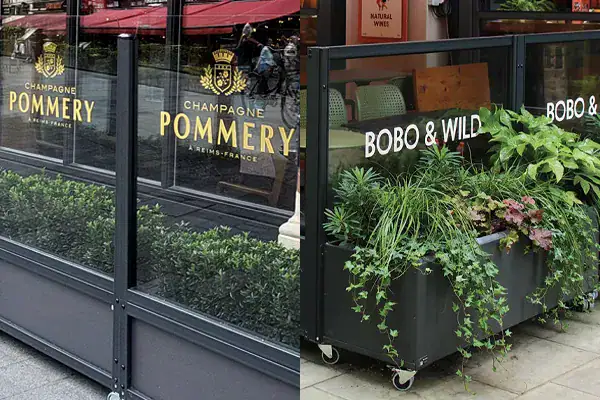
Plant terrace planters with hardy, low-maintenance plants that look full all year. Most venues choose:
- Evergreen shrubs or grasses, so the terrace does not look bare in winter.
- Compact plants that stay below the glass, so they do not block the view or the screen.
- Non-spiky plants at the walkway edge, to avoid catching pedestrians or guests.
- Seasonal colour in front of the evergreens, refreshed two or three times a year to keep the terrace looking new.
FAQs
What are planters with screens used for?
Planters with screens are used to mark out outdoor seating areas while sheltering guests from wind. On pavement terraces, they also separate diners from passing pedestrians and traffic, and add greenery and branding to the street.
Do I need permission for planters with screens on a pavement?
In England, furniture placed on the public highway for food and drink service needs a pavement licence from your council. GOV.UK’s guidance names barriers but not planters, so check how your council treats planter screens before installing them.
Can planters with screens be moved?
Yes, if you choose mobile or free-standing models. Mobile units roll on castor wheels so they can be cleared away at night, which helps meet the pavement licence requirement for removable furniture.
Can I add my logo to planter screens?
Yes. Logos and artwork can be applied to the glass or panels. Check with your council if the screens form your terrace edge, as GOV.UK guidance says advertising boards must not be used as barriers.
Are planters with screens suitable for windy or coastal streets?
Yes. Height-adjustable models such as the StarUp&Down planter let you raise the glass on windy days. Stainless steel AISI 316 bases are available for exposed or seaside locations.
Pavement terrace looking bare?
Request a free layout and quote
Send us a photo of your pavement terrace and your licence plan. Our in-house design team will propose planters with screens that fit your licensed area and keep the walkway clear, with a quote to match.